하드웨어
모터의 종류와 원리 1 - DC모터 - 이론
DC모터의 구성요소와 동작 원리를 단계별로 공부합니다.
권민재
모터란 무엇인가?
전기 등의 에너지를 공급받아 이를 기계적인 움직임으로 변환하는 장치입니다.
DC 모터의 구성요소
대표적인 DC 모터의 경우를 살펴보겠습니다.
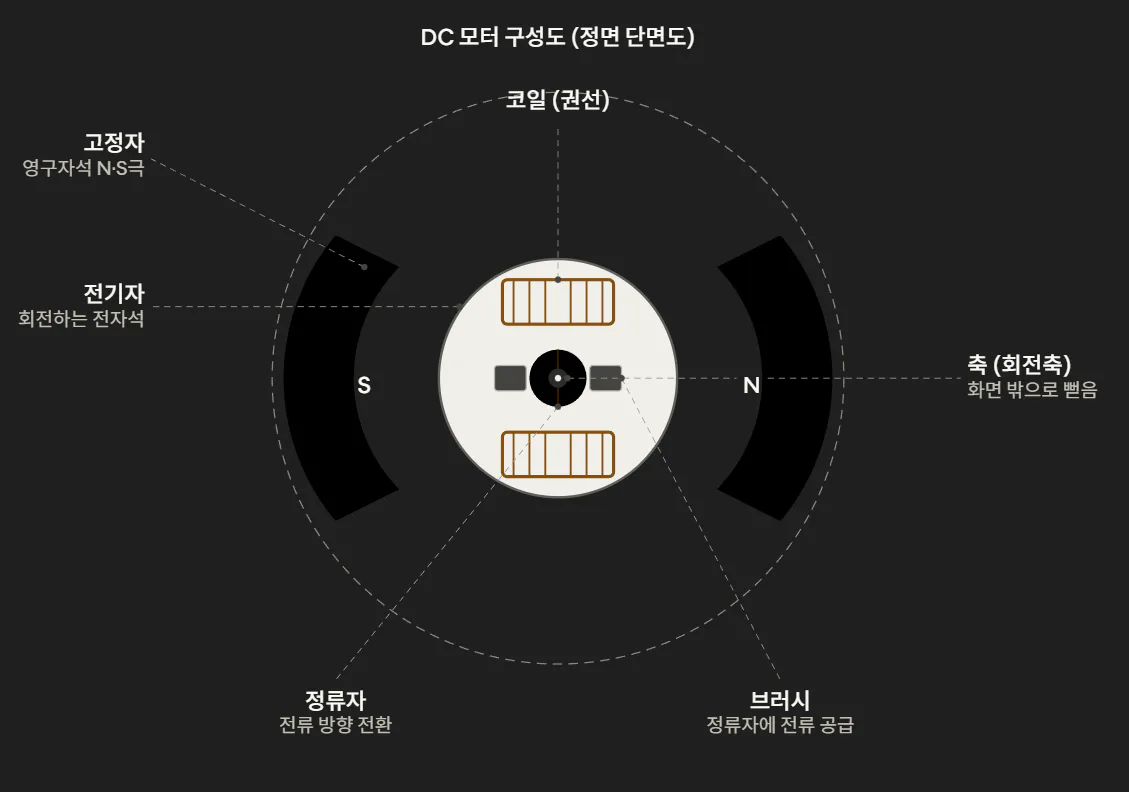

DC 모터는 고정자, 전기자(코일 포함), 정류자, 브러시, 축으로 구성되어 있습니다.
DC 모터의 동작원리
우선 DC모터의 내부에 고정자인 N극 S극에 해당하는 자석이 위치해있습니다.
이 두 자석은 모터 내부에 자기장을 한방향으로 정렬해주는 역할을 합니다.
이 자기장 안에서 먼저 전류가 외부 전원에서 브러시로 공급되고, 브러시가 회전 중인 정류자에 접촉하여 코일로 전류를 전달합니다.
이 때 힘이 작용하게 되는데 이 방향은 플레밍의 왼손법칙을 따릅니다. (B: 자기장, I: 전류, L: 자기장 안에 놓인 도선의 길이)
단순한 일자 도선으로 구성된다면 매우 약한 힘이지만, 도선을 N번 감아 코일로 만들면 자기장 안에 놓인 도선이 N배가 되는 효과가 있어 힘이 N배로 증폭됩니다.
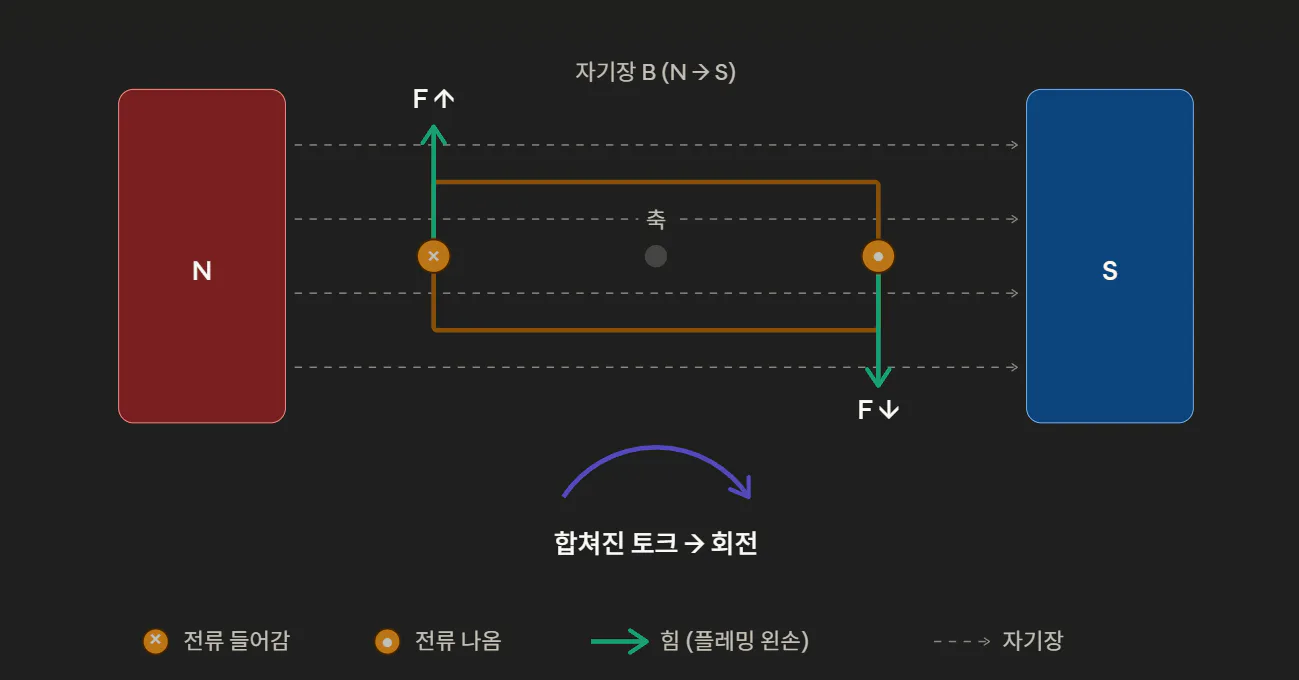
이렇게 토크가 만들어져 돌아가지만, 코일이 회전하면 위치가 계속 바뀌기 때문에 정류자는 반바퀴마다 브러시와의 접점을 바꿔 코일에 흐르는 전류 방향을 뒤집어줍니다.
이 덕분에 코일 위치가 바뀌어도 토크가 항상 같은 회전 방향을 유지할 수 있습니다.
또한 실제 모터는 여러 개의 코일과 여러 개의 세그먼트(분할된 금속 조각)를 사용하여,
항상 영구자석의 자기장으로부터 가장 가까운 코일에만 전류를 흘려 최대 토크를 안정적으로 유지합니다.
DC 모터의 힘을 키우는 방법
변수 | 키우는방법 | 트레이드 오프 |
|---|---|---|
N(권선수) | 코일을 더 많이 감는다 | 저항, 발열 증가 |
B(자기장) | 더 강한 자석(네오디뮴 등) | 비용, 무게 증가 |
I(전류) | 전류공급 증가 | 발열, 전선굵기 증가 |
L(도선길이) | 모터를 축 방향으로 확장 | 크기, 무게 증가 |
DC 모터의 장단점
장점
구조가 단순하여 전압만으로 속도조절이 가능하다, 제어가 쉽다.
별도 제어 회로 없이도 동작이 가능하다.
기동 토크가 크다.
단점
브러시-정류자의 기계적 마찰로 인해 수명이 짧다.
마찰로인한 스파크, 노이즈가 발생한다.
고속, 고출력 환경에서 효율이 떨어진다.
속도를 줄인다는 개념이 전압을 줄이는 것이기 때문에 저속에서의 최대 토크가 저하한다.
Why?: 동작중인 모터에서 전압이 줄어들면 최대 전류가 줄어들고, 이를 통해 최대 토크가 줄어든다.
위의 단점들로 인해 효율·수명·정밀 제어가 중요한 분야에서는 BLDC 모터로 바뀌는 추세.
DC 모터의 사용처
저렴한 장점: 완구류, 장난감등 저비용 시장.
별도제어회로가 못들어가는 소형 배터리 제품: 면도기, 칫솔
단순한 동작이 필요한 경우: 작은 팬, 자동차 와이퍼, 사이드미러
Types and Principles of Motors - DC Motors
We will study the components and operating principles of DC motors step by step.
What is a motor?
It is a device that converts energy, such as electricity, into mechanical motion.
Components of a DC Motor
Let’s take a look at a typical DC motor. A
DC motor consists of a stator, an armature (including coils), a commutator, brushes, and a shaft.
How a DC Motor Works
First, inside the DC motor, there are magnets corresponding to the north (N) and south (S) poles,
which form the stator. These two magnets align the magnetic field inside the motor in a single direction. Within
this magnetic field, current is first supplied from an external power source to the brushes, and the brushes make contact with the rotating armature to transmit the current to the coils.
At this point, a force is generated, and its direction follows Fleming’s left-hand rule. (B: Magnetic field, I: Current, L: Length of the wire placed within the magnetic field)
If the motor were constructed with a simple straight wire, the force would be very weak; however, when the wire is wound N times to form a coil, the effect is that the length of the wire within the magnetic field increases by a factor of N, amplifying the force by a factor of N.
Although torque is generated in this way to drive rotation, the coil’s position continuously changes as it rotates. Therefore, the commutator switches the contact points with the brushes every half-turn to reverse the direction of the current flowing through the coil. Thanks
to this, the torque maintains the same direction of rotation even as the coil’s position changes.
Additionally, actual motors use multiple coils and multiple segments (segmented metal pieces) to ensure that current flows only through the coil closest to the permanent magnet’s magnetic field at any given time
, thereby stably maintaining maximum torque.
How to Increase the Power of a DC Motor
Variables | How to Increase | Trade-offs |
|---|---|---|
N (Number of Windings) | Wind more coils | Increased resistance and heat generation |
B (Magnetic Field) | Stronger magnets (e.g., neodymium) | Increased cost and weight |
I (Current) | Increased current supply | Heat generation, increased wire gauge |
L (wire length) | Extending the motor axially | Increased size and weight |
Advantages and Disadvantages of DC Motors
Advantages
The simple structure allows speed control using only voltage; control is easy.
Can operate without a separate control circuit.
High starting torque.
Disadvantages
Short service life due to mechanical friction between the brushes and commutator.
Friction causes sparks and noise.
Efficiency decreases in high-speed, high-power environments.
Since reducing speed involves reducing voltage, maximum torque at low speeds decreases.
Why?: When the voltage of a running motor decreases, the maximum current decreases, which in turn reduces the maximum torque.
Due to the above disadvantages, there is a trend toward switching to BLDC motors in fields where efficiency, lifespan, and precise control are critical.
Applications of DC Motors
Cost-effectiveness: Low-cost markets such as toys and similar products.
Small battery-powered products that cannot accommodate separate control circuits: electric shavers, electric toothbrushes
Applications requiring simple motion: small fans, car windshield wipers, side mirrors