하드웨어
모터의 종류와 원리 4 - Servo모터 - 이론
모터의 종류 중 Servo모터에 대하여 구조와 원리, 장단점과 사용처에 대해 간단히 알아봅니다.
권민재
배경 지식
엔코더란?
엔코더는 위치나 속도를 전기적인 신호로 바꾸어주는 장치입니다.
엔코더의 출력방식의 구분
엔코더의 종류는 크게 증분형, 절대치형으로 구분이 가능하고, 증분형은
회전체가 회전할때마다 펄스를 발생시켜 상대적으로 얼마나 변화하였는지를 보는 방법이고,
절대치형은 위치마다 고유의 값이 있어서 전원이 꺼져도 위치를 기억할수 있는 방법입니다.
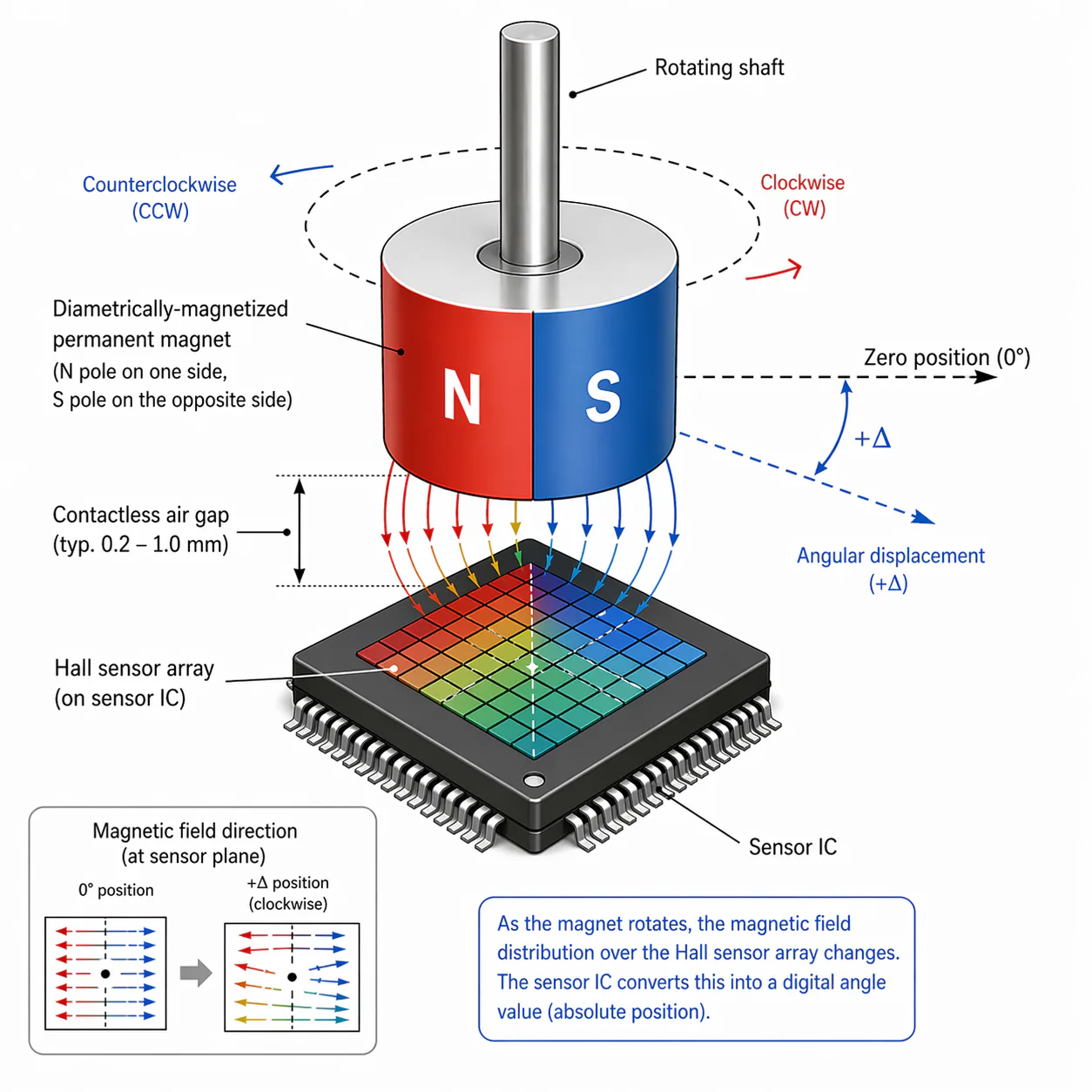
엔코더의 감지원리의 종류
빛(LED)를 이용하는 광학식 방식과 자석을 이용하는 자기식 방법이 있습니다.
PPR이란?
PPR은 Pulses Per Revolution의 약자로 1회전당의 펄스 수 1회전을 몇개로 쪼갤 수 있는지에 대한 척도를 나타냅니다.
360 PPR이면360도를 1도 단위로 쪼갤 수 있는 정밀도로 이해하면 좋을 것 같습니다.
PPR이 높으면 고정밀, 낮으면 저정밀로 이해하면 쉽습니다.
CPR이란?
CPR은 Counts Per Revolution의 약자로 1회전에 내가 셀수 있는 갯수를 뜻합니다.
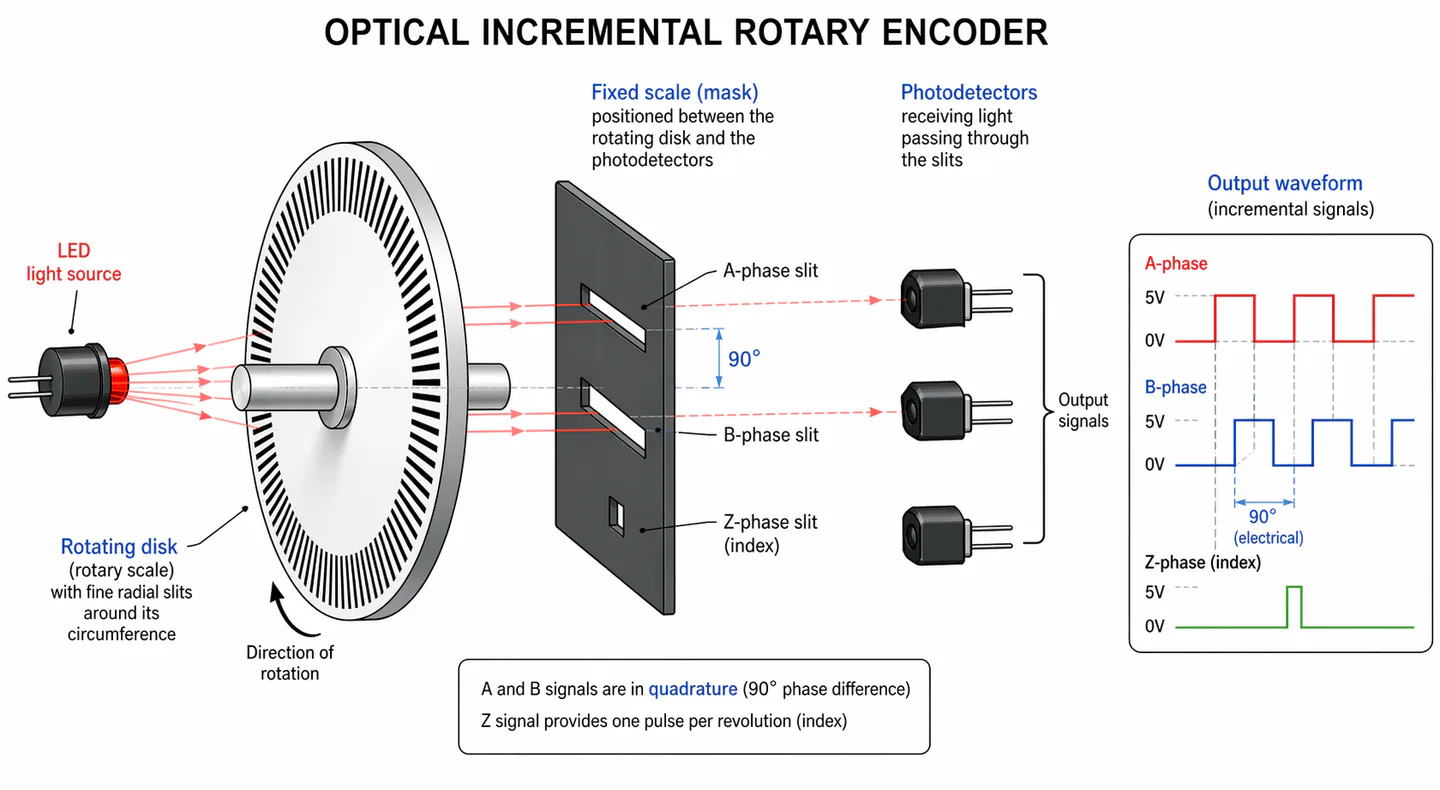
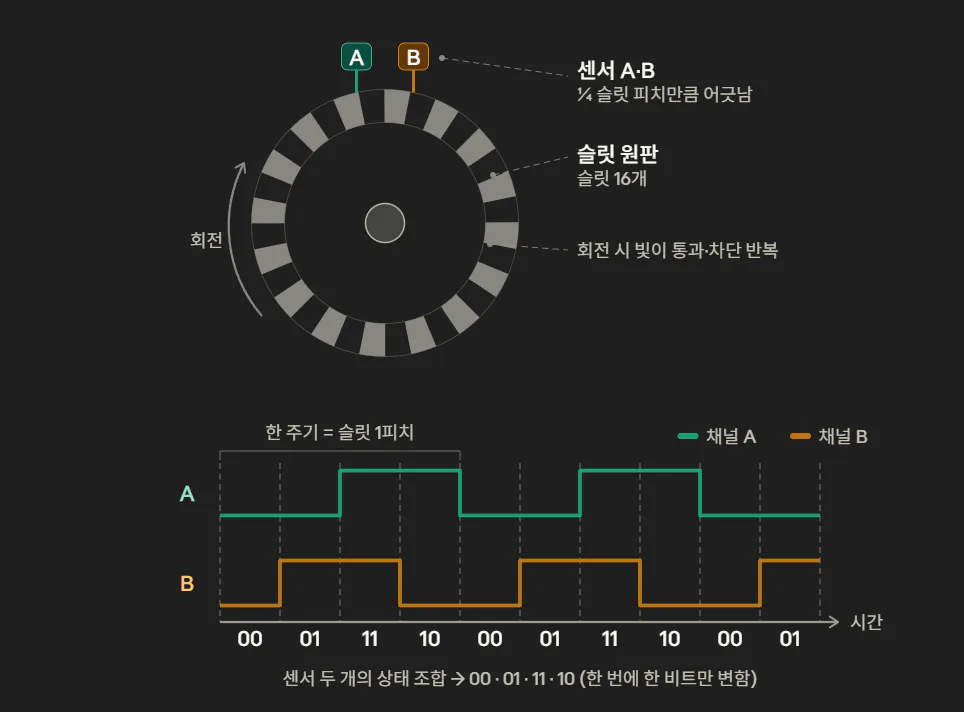
이전에 말했던 광학식 엔코더를 통해 해당원리를 설명해보겠습니다. PPR은 물리적인 홈의 갯수로 나타낼 수 있고
이에 위치를 다르게 하는 수신부, 포토센서90도의 위상차를 가지도록 달게 되면 위상이 A/B, 2개로 생기게 됩니다.
이를 통해 모터가 현재 어느방향(A가 먼저 1로 바뀌면 정방향, B가 먼저 바뀌면 역방향으로 생각해볼 수 있겟죠?)으로 돌아가는지,
지금 어느정도 회전했는지에 대한 정보를 인지할 수 있습니다. 따라서 PPR 하나를 통해 얻어낼 수 있는 조합식은 00 01 10 11 4가지로 나오게 됩니다.
따라서 이를 식으로 정리해본다면
Bit란?
이전에 1회전을 몇번으로 쪼개느냐로 PPR/CPR로 표현했었습니다, 해당방식들은 펄스의 갯수를 세는 방식으로 주로 증분형에 사용되는 방식들입니다.
따라서 각 위치마다 고유한 디지털 값을 새기면서 동작하는 절대치 방식에서는 컴퓨터에서 알아보기 쉽도록한 2진수 단위인 Bit로 설정하여 표현합니다.
10 Bit면 1회전을
그래서, 서보모터가 무엇인가.
서보모터를 간단하게 표현하자면 "폐루프 제어방식이 추가 된 모터"라고 할 수 있습니다.
특정 모터를 의미하는것은 아니고, 제어방식에 가깝다고 보는데, 기존의 DC, BLDC에도 엔코더가 들어가는경우가 있습니다.
하지만 12 bit, 2,500 PPR 이상의 엔코더와 드라이버를 결합한다면, 목표로 하는 위치/속도/토크를 실제값과 비교하면서 센서의 피드백을 통해
실시간으로 보정할 수 있기 때문에 이를 폐루프 제어방식이 적용된 모터로 규정하고 서보모터로써 분류됩니다.
Types and Principles of Motors - Servo Motors - Theory
Let’s take a brief look at servo motors—one type of motor—covering their structure, operating principles, advantages and disadvantages, and applications.
Background Information
What is an encoder?
An encoder is a device that converts position or speed into an electrical signal.
Classification of Encoder Output Methods
Encoders are broadly classified into incremental and absolute types. Incremental encoders generate a pulse each time
the rotating shaft turns, allowing the system to track relative changes in position.
Absolute encoders assign a unique value to each position, enabling them to retain position information even when the power is turned off.
Types of Encoder Sensing Principles
There are optical methods that use light (LEDs) and magnetic methods that use magnets.
What is PPR?
PPR stands for Pulses Per Revolution and indicates the number of pulses per revolution, serving as a measure of how finely a single revolution can be divided.
A 360 PPR value can be understood as the precision to divide 360 degrees into 1-degree increments.
It is easy to understand that a high PPR indicates high precision, while a low PPR indicates low precision.
What is CPR?
CPR stands for Counts Per Revolution and refers to the number of counts that can be recorded per revolution.
Let’s explain this principle using the optical encoder mentioned earlier. PPR can be represented by the number of physical grooves.
If the receiver and photosensor are mounted with a 90-degree phase difference, two phases—A and B—are generated.
This allows us to determine which direction the motor is currently rotating (if A changes to 1 first, it’s forward; if B changes first, it’s reverse, right?) and
how much it has rotated. Therefore, the possible combinations obtainable from a single PPR are 00, 01, 10, and 11.
If we express this mathematically, it
What is a bit?
Previously, we expressed PPR and CPR in terms of how many parts a single rotation was divided into. These methods primarily count the number of pulses and are typically used in incremental systems.
In contrast, absolute systems operate by assigning a unique digital value to each position; to make this easily readable by a computer, they are expressed in bits, which are binary units.
10 bits means that one full rotation is divided
So, what is a servo motor?
Simply put, a servo motor can be described as a "motor with closed-loop control." It does not refer
to a specific type of motor but rather to a control method; even conventional DC and BLDC motors can sometimes be equipped with encoders.
However, when combined with an encoder and driver capable of 12 bits or more and 2,500 PPR or higher, the system can compare the target position, speed, and torque with actual values and make real-time
corrections based on sensor feedback. Consequently, such a system is defined as a motor with closed-loop control and is classified as a servo motor.