하드웨어
기어의 종류 3 - 엇갈림축 기어
엇갈림 축 기어의 세계: 웜, 하이포이드, 스크류 기어 알아보기
권민재
엇갈림 축에 해당하는 기어들에 대해 알아보겠습니다.
분류 | 기어종류 |
|---|---|
엇갈림축 | 웜 & 웜휠기어, 하이포이드기어, 스크류기어 |
웜 & 웜휠기어
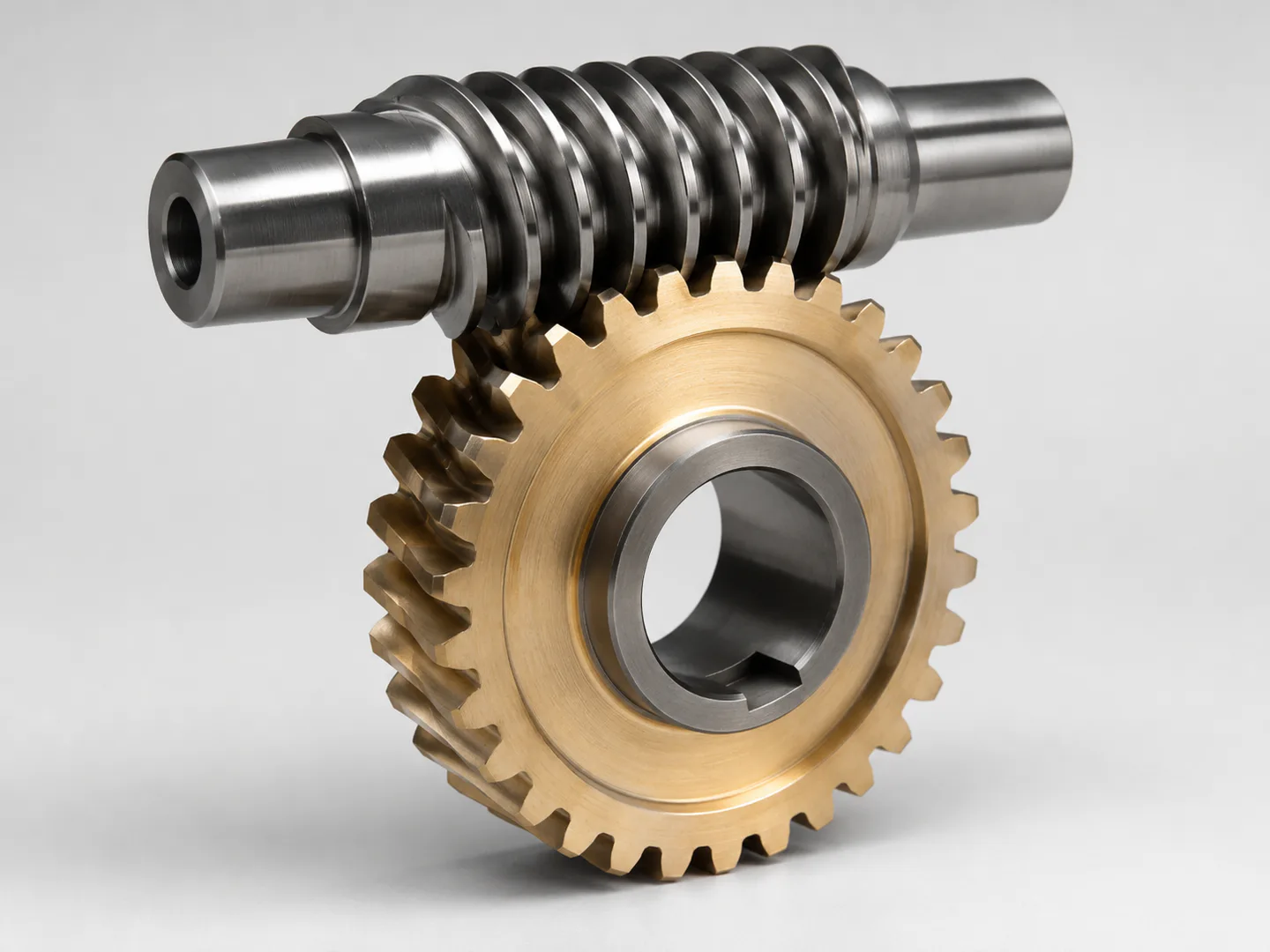
웜 & 웜휠기어는 나사 형태의 웜 과 헬리컬 기어 형태의 웜휠이 맞물려 동력을 전달하는 기어입니다. 엇갈림축 구조이며, 일반적으로 두 축이 직각으로 어긋나 배치됩니다.
웜이 한 바퀴 돌면 웜휠은 웜의 줄수(나사산 개수)만큼만 이가 진행되므로, 단일로 1:10 ~ 1:100 수준의 고감속비를 얻을 수 있는 것이 특징입니다.
또한 마찰각이 마찰계수보다 클 경우 웜휠 쪽에서 웜을 역으로 돌릴 수 없는 자동잠금 특성이 나타나,
정지 상태에서 별도의 브레이크 없이 부하를 지지할 수 있어 엘리베이터, 계폐 장치, 컨베이어 등 부하가 역구동되면 안 되는 시스템에 사용됩니다.
단점은 잇면 사이에 미끄럼 접촉이 발생한다는 점입니다. 이로 인해 마찰 손실이 커서 효율이 40~90% 수준으로 다른 기어 대비 낮아 발열·마모 가 발생합니다.
하이포이드 기어
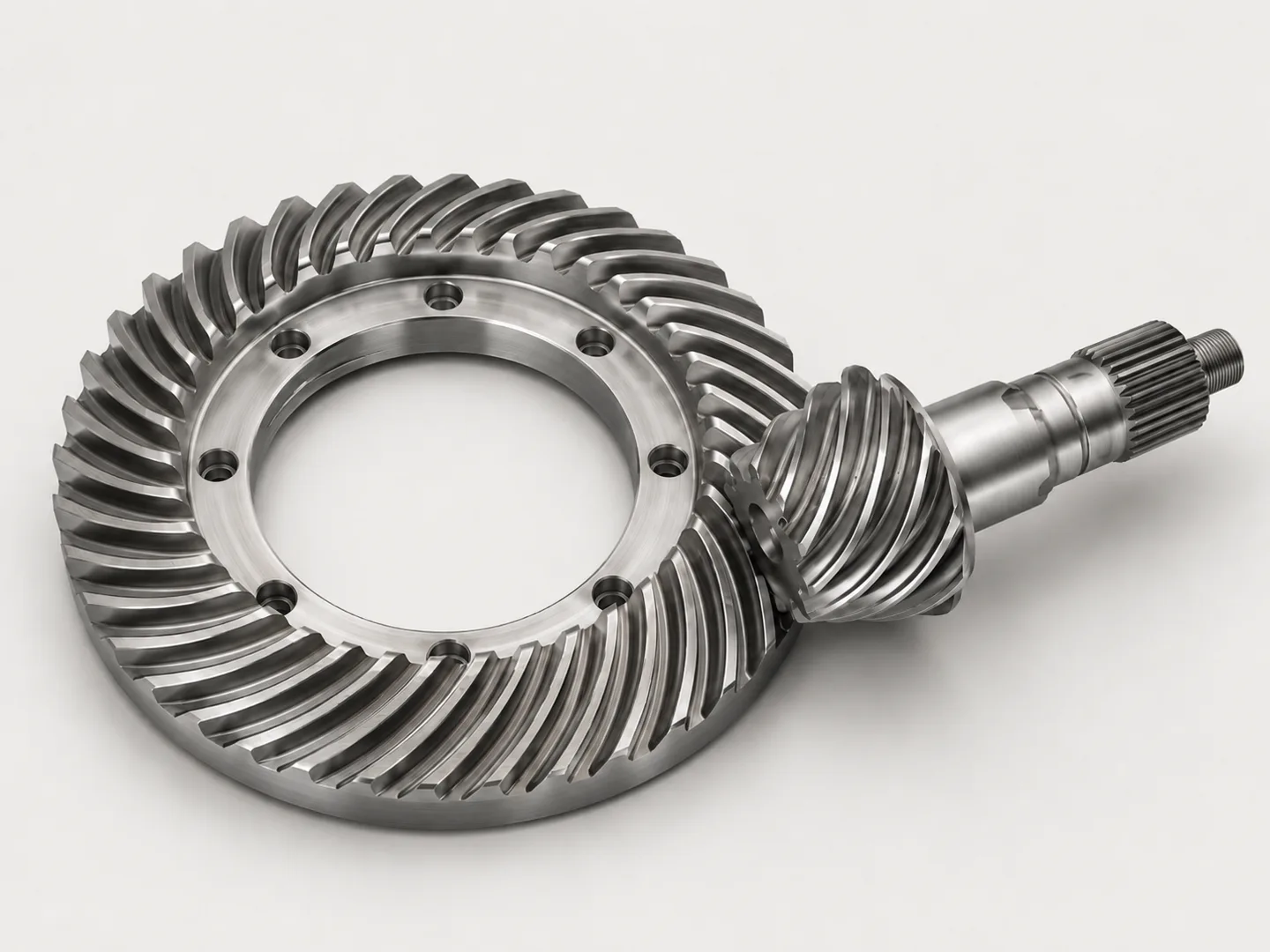
하이포이드 기어는 스파이럴 베벨기어의 변형으로, 두 축이 한 점에서 만나지 않고 축이 어긋난 상태로 동력을 전달하는 기어입니다.
축이 교차하지 않기 때문에 베벨 패밀리에 속하면서도 분류상으로는 엇갈림축으로 분류됩니다.
피니언이 링기어 중심선에서 오프셋되어 배치되므로, 같은 감속비에서 피니언 직경을 크게 만들 수 있어 강성과 하중 용량이 높고,
큰 나선각 덕분에 동시 접촉 잇수가 많아 베벨 패밀리 중 가장 정숙한 맞물림을 보입니다.
단점은 잇줄 방향으로 미끄럼 접촉이 발생한다는 점입니다. 이로 인해 효율이 스파이럴 베벨보다 다소 낮고, 극압(EP) 첨가제가 포함된 전용 기어유(GL-5 등급) 가 필수적입니다. 대표적인 사용처는 자동차의 종감속·차동장치로, 오프셋 구조 덕분에 프로펠러 샤프트를 차체 아래쪽으로 낮게 배치할 수 있어 후륜·사륜구동 차량의 실내 바닥 평탄화에 결정적인 역할을 합니다.
스크류기어
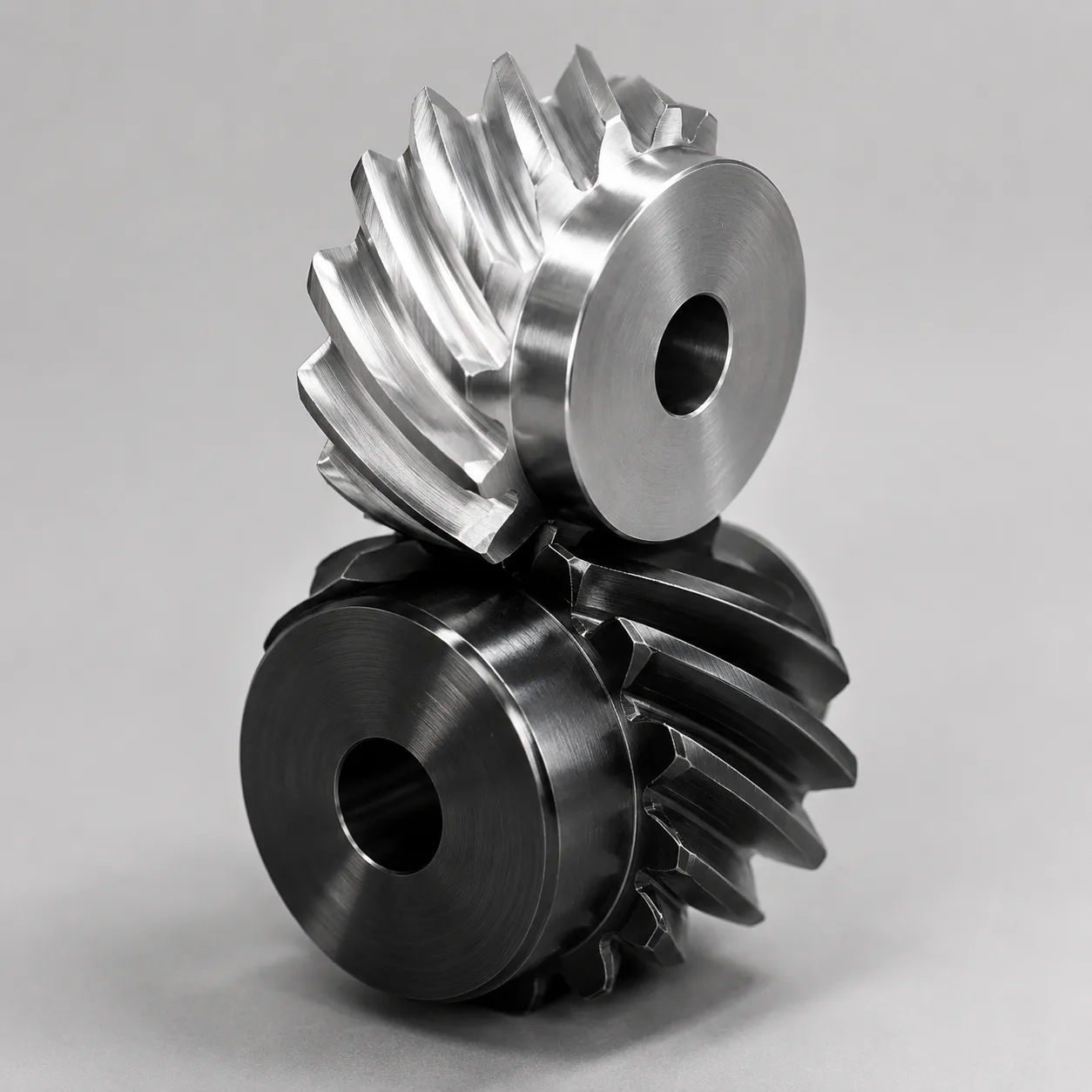
스크류 기어는 두 개의 헬리컬 기어를 엇갈림축으로 맞물려 동력을 전달하는 기어입니다. 두 기어 모두 직각으로 어긋난 상태로 배치됩니다.
형태로는 평행축에서 사용하는 헬리컬 기어와 동일하지만, 두 기어의 나선 방향이 같고 축이 어긋나 있다는 점이 다릅니다.
평행축 헬리컬 기어가 선접촉으로 맞물리는 것과 달리, 스크류 기어는 점접촉으로 맞물리는 것이 구조적 특징입니다.
장점은 두 축의 위치 관계를 자유롭게 설정할 수 있고, 가공이 간단한 헬리컬 기어를 그대로 사용할 수 있어 제작이 쉽고 비용이 낮다는 점입니다.
웜 기어처럼 엇갈림축 동력 전달이 가능하면서도 구조가 훨씬 단순합니다.
단점은 점접촉으로 면적이 작아 하중 용량이 매우 낮고, 미끄럼 접촉이 크기 때문에 마모가 빠르며 효율도 낮습니다. 따라서 저하중·저속의 보조 동력 전달에 사용합니다.
Types of Gears 3 - Crossed-Axis Gears
The World of Non-Parallel-Axis Gears: Exploring Worm, Hypoid, and Screw Gears
Let's take a look at the gears that correspond to the cross-axis.
Classification | Types of Gears |
|---|---|
Helical | Worm & Worm Wheel Gears, Hypoid Gears, Screw Gears |
Worm & Worm Wheel Gears
Worm & worm wheel gears are gears in which a screw-shaped worm meshes with a helical-tooth worm wheel to transmit power. They feature a helical-axis structure, and the two shafts are typically arranged at right angles to each other.
Since the worm wheel advances by only the number of threads on the worm for every full rotation of the worm, this gear system is characterized by its ability to achieve a high reduction ratio of 1:10 to 1:100.
Additionally, when the friction angle exceeds the coefficient of friction, a self-locking characteristic prevents the worm from being turned backward from the worm wheel side. This allows the system to support a load without a separate brake while stationary, making it suitable for systems where reverse rotation of the load must be prevented, such as elevators, gate closing mechanisms, and conveyors.
A disadvantage is that sliding contact occurs between the teeth. This results in high friction losses, leading to an efficiency of 40–90%, which is lower than that of other gears, causing heat generation and wear.
Hypoid Gears
Hypoid gears are a variant of spiral bevel gears; they transmit power with the two shafts offset from each other rather than meeting at a single point. Because the shafts do not intersect, they belong to the bevel gear family but are classified as offset-axis gears.
Since the pinion is offset from the ring gear’s centerline, the pinion diameter can be made larger for the same reduction ratio, resulting in high rigidity and load capacity. Additionally, the large helix angle allows for a high number of teeth in simultaneous contact, making it the quietest meshing gear within the bevel family.
A drawback is that sliding contact occurs along the tooth flank. As a result, efficiency is slightly lower than that of spiral bevel gears, and a dedicated gear oil containing extreme pressure (EP) additives (GL-5 grade) is essential. Typical applications include automotive final drives and differentials. Thanks to their offset structure, the propeller shaft can be positioned low beneath the vehicle body, playing a crucial role in achieving a flat floor in the cabin of rear-wheel-drive and all-wheel-drive vehicles.
Screw Gears
A screw gear is a type of gear that transmits power by meshing two helical gears on intersecting axes. Both gears are arranged at a right angle to each other.
In terms of form, it is identical to the helical gears used in parallel-axis systems, but differs in that the two gears have the same direction of helical pitch and their axes are offset. Unlike parallel-axis helical gears, which engage via line contact, the structural characteristic of a screw gear is that it engages via point contact.
The advantages include the ability to freely configure the positional relationship between the two shafts, as well as the fact that standard helical gears—which are simple to machine—can be used as-is, making production easy and cost-effective. It enables power transmission between offset shafts, similar to a worm gear, but with a much simpler structure.
The disadvantages are that the small contact area resulting from point contact leads to very low load capacity, and the high degree of sliding contact causes rapid wear and low efficiency. Therefore, they are used for auxiliary power transmission under low-load and low-speed conditions.